
FLUX.1
The highest quality model family. T5-XXL + CLIP-L text encoding with a flow-matching transformer.
- Developer: Black Forest Labs
- License: Apache 2.0 (Schnell), FLUX.1 Dev Non-Commercial (Dev)
- HuggingFace: black-forest-labs/FLUX.1-schnell, black-forest-labs/FLUX.1-dev
Variants
| Model | Steps | Size | Notes |
|---|---|---|---|
flux-schnell:q8 | 4 | 12 GB | Fast, general purpose |
flux-schnell:q6 | 4 | 9.8 GB | Best quality/size trade-off |
flux-schnell:bf16 | 4 | 23.8 GB | Full precision (>24 GB VRAM) |
flux-schnell:q4 | 4 | 7.5 GB | Lighter |
flux-dev:q8 | 25 | 12 GB | Full quality |
flux-dev:q6 | 25 | 9.9 GB | Best quality/size trade-off |
flux-dev:bf16 | 25 | 23.8 GB | Full precision (>24 GB VRAM) |
flux-dev:q4 | 25 | 7 GB | Full quality, less VRAM |
Fine-Tunes
| Model | Steps | Size | Style |
|---|---|---|---|
flux-krea:q8 | 25 | 12.7 GB | Aesthetic photography |
flux-krea:q6 | 25 | 9.8 GB | Aesthetic photography |
flux-krea:q4 | 25 | 7.5 GB | Aesthetic photography |
flux-krea:fp8 | 25 | 11.9 GB | Aesthetic photography |
jibmix-flux:fp8 | 25 | 11.9 GB | Photorealistic |
jibmix-flux:q5 | 25 | 8.4 GB | Photorealistic |
jibmix-flux:q4 | 25 | 6.9 GB | Photorealistic |
jibmix-flux:q3 | 25 | 5.4 GB | Photorealistic, lighter |
ultrareal-v4:q8 | 25 | 12.6 GB | Photorealistic (latest) |
ultrareal-v4:q5 | 25 | 8.0 GB | Photorealistic |
ultrareal-v4:q4 | 25 | 6.7 GB | Photorealistic, lighter |
ultrareal-v3:q8 | 25 | 12.7 GB | Photorealistic |
ultrareal-v3:q6 | 25 | 9.8 GB | Photorealistic |
ultrareal-v3:q4 | 25 | 6.8 GB | Photorealistic, lighter |
ultrareal-v2:bf16 | 25 | 23.8 GB | Full precision |
iniverse-mix:fp8 | 25 | 11.9 GB | Realistic SFW/NSFW mix |
Recommended Dimensions
| Width | Height | Aspect Ratio |
|---|---|---|
| 1024 | 1024 | 1:1 (native) |
| 1024 | 768 | 4:3 |
| 768 | 1024 | 3:4 |
| 1024 | 576 | 16:9 |
| 576 | 1024 | 9:16 |
| 768 | 768 | 1:1 |
Using non-recommended dimensions will trigger a warning. All values must be multiples of 16.
Examples
FLUX Schnell Q8: 4 steps, seed 42:
mold run flux-schnell:q8 \
  "A majestic snow leopard perched on a Himalayan cliff \
  at golden hour, cinematic lighting, photorealistic" \
  --seed 42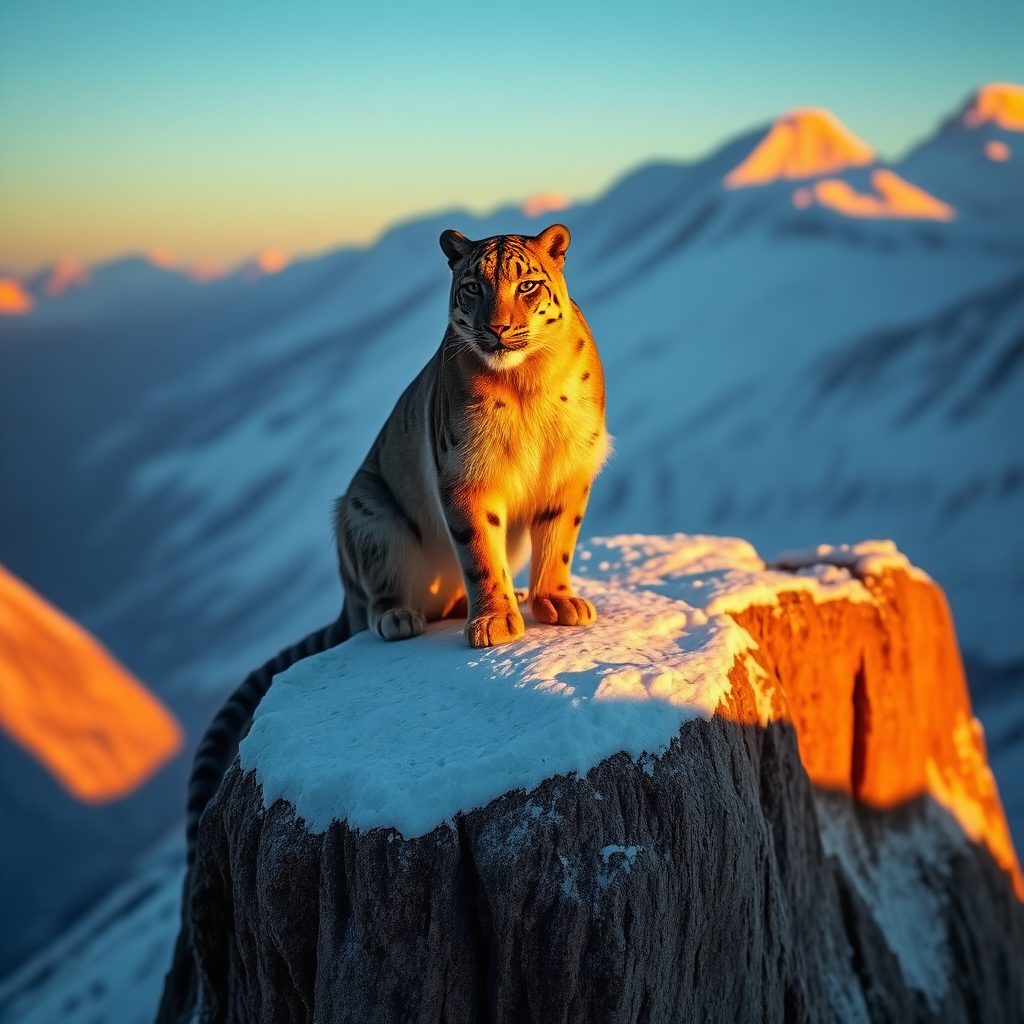
FLUX Dev Q4: 25 steps, seed 1337:
mold run flux-dev:q4 \
  "A cozy Japanese tea house interior with warm lantern light, \
  steam rising from ceramic cups, watercolor style" \
  --seed 1337
LoRA Support
FLUX models support LoRA adapters in both BF16 and GGUF quantized modes:
mold run flux-dev:bf16 "a portrait" --lora style.safetensors --lora-scale 0.8
mold run flux-dev:q4 "a portrait" --lora style.safetensors --lora-scale 0.8
Speed
On CUDA, FLUX renders through FlashAttention-2 and cuDNN by default wherever the artifact compiled them: mold (sm89), mold-sm86, mold-sm100 and the matching desktop packages compile both.
mold-sm120 is the exception and uses math attention. FlashAttention picks its tile from a runtime check that reads consumer Blackwell as a large-shared-memory datacenter part, which it is not, so an RTX 50-series card would get a tile tuned for an A100 — correct, but of unmeasured speed, and mold has no 50-series card to measure it on. It is qualified there when someone measures it. The byte change below still applies to that artifact: it is a property of every CUDA build, not of the kernel.
A build you make yourself with --features cuda and no flash-attn is in the same position — correct, byte-changed, and on the math path — so add flash-attn to the feature list on sm86, sm89 or sm100. Metal builds have no flash kernel at all. The GGUF tiers also run their activations in BF16 rather than F32, which halves the bandwidth every matmul moves and lets the tensor cores engage; candle's quantized kernels take BF16 and return it, so the weights stay quantized in VRAM exactly as before. Set MOLD_ATTN=math and MOLD_CONV=im2col to render the byte-stable way instead.
A FLUX print archived before mold 0.29 will not re-render byte-for-byte after it, under any setting: flash attention, cuDNN and BF16 activations all change the order the same sums are accumulated in. Renders made from 0.29 on are reproducible among themselves — same seed, same settings, same backend, same bytes.
The full-precision :bf16 tier is the one exception on the attention side: it runs through upstream Candle's own attention, which has no backend switch, so it stays on the math path.
Under that, a step spends much less time in its small operations: the Q/K norms and the affine-less LayerNorms now hit candle's fused kernels instead of a ten-operation strided fallback, and the rotary embedding takes candle's fused interleaved kernel wherever the layout allows. FLUX.1 also builds that rotary embedding in float32, as upstream does — it previously used whatever dtype the render was in, so a half-precision render computed every sine and cosine of every token position with eight bits of mantissa. That one is a correctness fix, and it changes the picture.
Loading a GGUF checkpoint
A whole quantized checkpoint is read in contiguous batches across eight threads into a reused page-locked staging buffer, and uploaded to the GPU from there with two buffers alternating so one is filling while the other is still in flight. It used to be read through a memory mapping, which on ZFS — where $MOLD_HOME lives on every machine mold is qualified on — is one page fault per 4 KiB with no readahead. Measured with the file's page cache dropped, flux1-dev-Q8_0 went from 15.5 s to 1.6 s. The weights are byte-identical, so renders are too. macOS and CPU keep the mapping, where staging would be a pure extra copy.
Memory
The transformer stays on the card when it fits
mold used to drop the transformer before every VAE decode and rebuild it on the next render, whatever the card had room for. On a 46 GB GPU that is 8.4 seconds of disk read per print for a Q8 tier, and with a LoRA stack the rebuild peaks at around 95 GB of host RAM.
The decision is now a measurement, taken per render: the resident checkpoint, this render's denoise workspace, the VAE decode's workspace and a 1 GB allocator margin, against the card's usable free VRAM. The three workspace terms are added rather than maxed, because the answer has to hold for the denoise and the decode both.
The canvas is part of that sum — the decode workspace is about 2.7 GB in bf16 at 1024x1024 and grows with area — but FLUX renders are capped at 1.8 megapixels (1328x1328 at the square), so across the whole range mold will actually render, the answer comes down to the checkpoint and the card:
- 24 GB keeps a Q8 tier (~12.6 GB) resident, and never has room for the BF16 one (~23.8 GB).
- 46 GB keeps the BF16 tier resident as well.
MOLD_FLUX_KEEP_TRANSFORMER=0 (also off, false, no) forces the old drop if you need the VRAM for something else. =1 (also on, true, yes) is accepted and means the same thing as the default: an explicit keep has always had to yield to a card that cannot afford it, and the budget is now what expresses that for everyone. One function answers for FLUX.1 and FLUX.2 alike.
What the print's execution fingerprint records is the request, not the outcome: 0 is its own execution class and unset and 1 share the other, so a forced drop is never filed with a budgeted render. It cannot record the outcome — that is a per-render measurement against whatever VRAM happened to be free, so two prints made by the same command on the same card can legitimately differ and are still the same execution. The measurement is reported in the server log instead, one line per render, naming which way it went and why: Transformer kept resident: the residency budget fits, Transformer dropped before VAE decode: the residency budget does not fit this card at this resolution, or Transformer dropped before VAE decode (MOLD_FLUX_KEEP_TRANSFORMER=0).
Text encoders
T5 and CLIP are dropped after they encode, so the denoise has the VRAM. MOLD_KEEP_TE_RAM=1 parks them in host RAM between requests instead, which turns a cache-miss prompt into a host-to-device copy rather than a re-read from disk. That is unchanged for FLUX.1, and it still costs one copy rather than the two it used to: parking a 9.79 GB T5 briefly needed 19.6 GB, for a feature whose purpose is fitting that encoder in host RAM.
The variable is now tri-state, but the third state is about the other families. Unset is auto, and auto measures the host — it parks only when the encoder, the transformer loading beside it, and a max(15% of RAM, 8 GiB) safety floor all fit in available memory — for the encoders that decision was built for: Flux.2's Mistral3 and Qwen3, and Z-Image's Qwen3. FLUX.1's T5 and CLIP keep the old rule, so unset still means "do not park" here. 0 never parks anywhere, and Metal never parks at all — there the parked copy would sit in the pool the encoder already runs from.
VRAM notes
- Full BF16 (23 GB) auto-offloads on 24 GB cards; blocks stream CPU↔GPU. The decision asks what the card has free, not only what the file weighs, so a 23.8 GB checkpoint no longer streams on a 46 GB GPU that could hold it.
- GGUF quantized (Q4/Q8) fits without offloading
- Use
--eagerto keep encoders loaded between generations (faster, more VRAM) - T5-XXL encoder auto-selects quantized variant when VRAM is tight